The Dragon of Gower
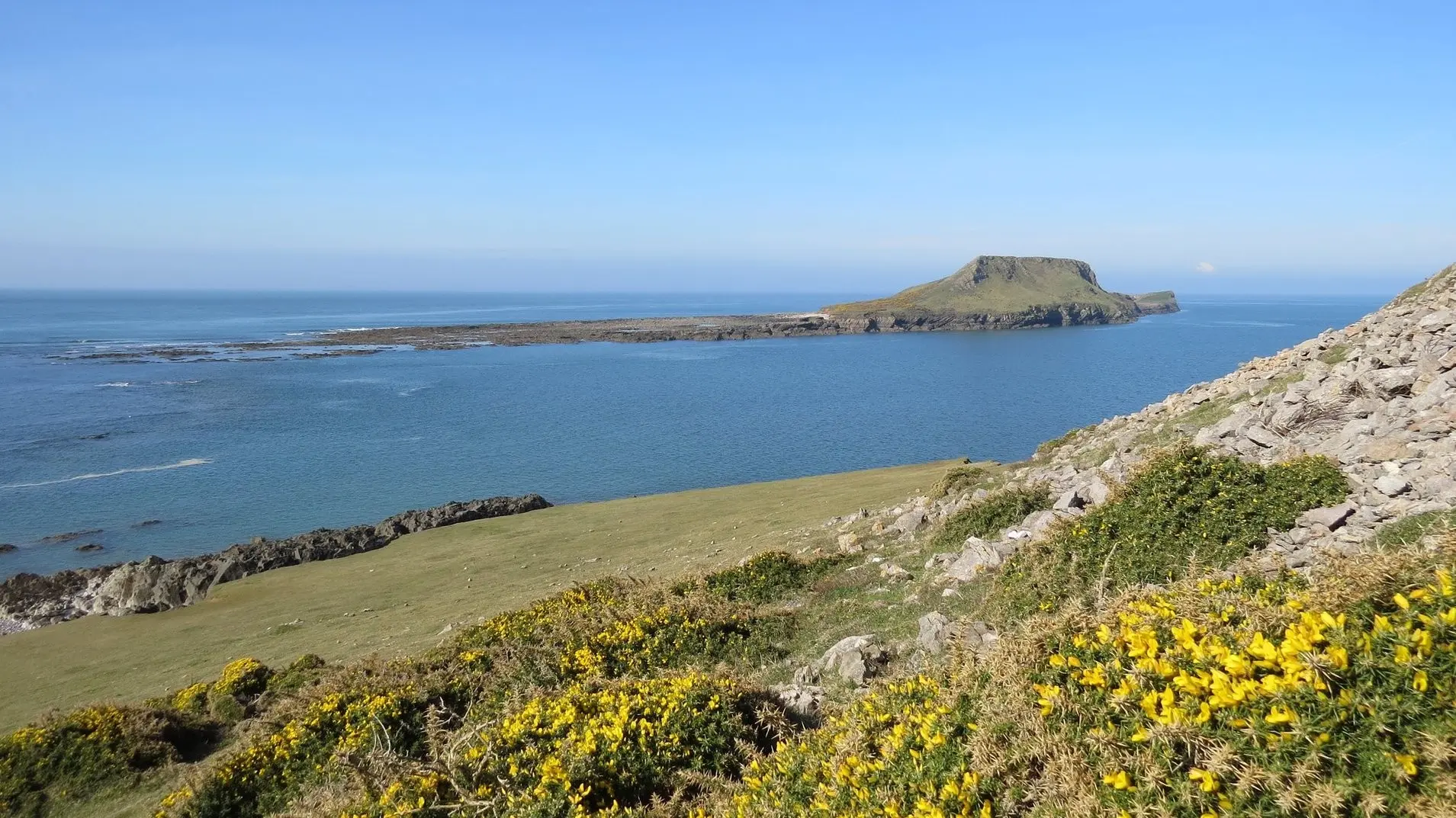
Local tradition holds that a Viking raiding party came ashore here in 986AD. They are said to have named the island after the Old Norse word ormr, meaning serpent or dragon, because of its shape, and over time the name became the “Worm”. Rising dramatically from the waves at the westernmost tip of Gower, the promontory resembles a gigantic prehistoric beast resting out in the Bristol Channel.
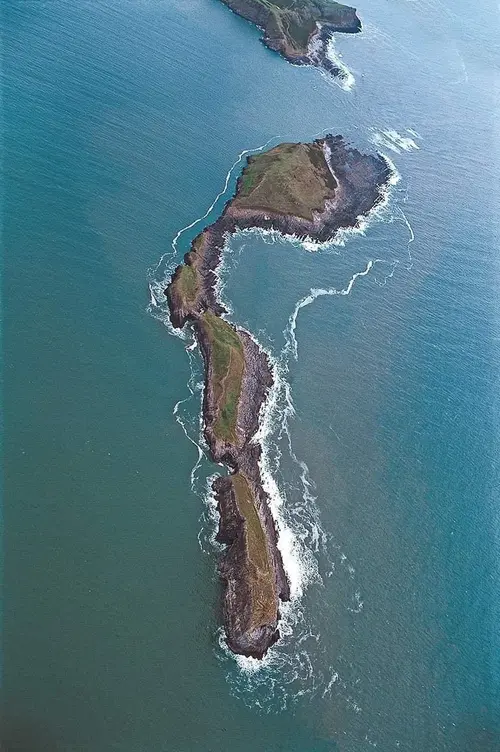
Stretching approximately a mile out to sea, the formation is split into three distinct sections: the Inner Head, the Middle Head, and the jagged Outer Head, linked together by low rocky necks and natural bridges formed by millions of years of marine erosion.
In stormy weather, the blow hole on the Outer Head still booms and hisses like a dragon, and on the highest spring tides the sea separates the Inner and Outer Heads, so the Worm looks as if it’s swimming.
Dylan Thomas & The Unscheduled Night
Wales’ most celebrated poet, Dylan Thomas, was captivated by Rhosili and the Worm. In his autobiographical story ‘Extraordinary Little Cough’ (from Portrait of the Artist as a Young Dog), he described Rhosili Bay as "the wildest, biggest and most beautiful beach in all the world."
"I stayed on the swinging bridge until the tide came in... and the sea rolled over the rocks and cut me off from the mainland."— Dylan Thomas
In 1933, a young Dylan fell asleep on the rocks of the Worm, lost track of time, and became trapped by the rising tide. Forced to spend a freezing, uncomfortable night stranded on the island until the morning ebb tide, his misadventure remains one of Gower's most famous literary anecdotes.
Dylan later called Worms Head the “very promontory of depression”, and claimed that rats nibbled his toes in the dark. Or perhaps it was the resident dragons.
Rhosili Old Rectory
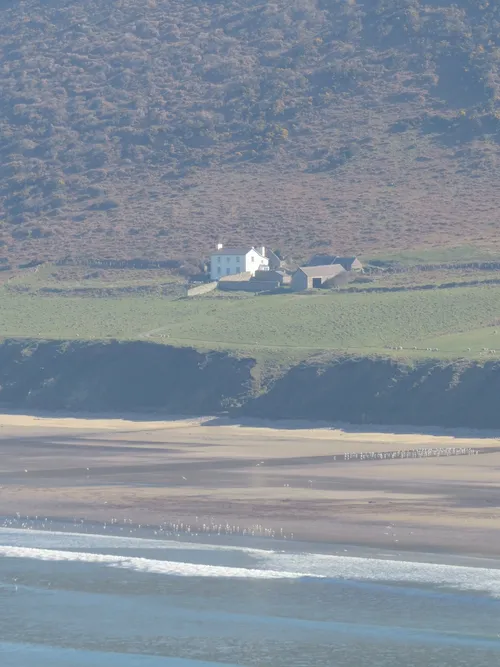
The white house standing alone above Rhosili beach is the Old Rectory, built in the 1850s on the site of much older buildings. It housed the rector who served several villages along this rural coast, and it is said to be one of the most haunted buildings on Gower.
During the Second World War it was a base for radar workers, and its striking setting has since made it a filming location for Torchwood: Miracle Day.
A former rector and his wife reported often seeing a couple in Edwardian dress standing on the stairs. On the beach below, the ghost of Reverend Lucas is said to still ride his horse across the sands to preach in Rhosili and Llangennith. On foggy nights, Squire Mansell’s carriage is said to race along the shore as he searches for hidden gold.
There are darker tales too. In winter, a figure in black has been seen rising from the sea and walking to the Rectory door. Inside, visitors describe cold spots in the corridors and a gruff voice whispering, “Why don’t you turn around and face me?” Those brave enough to turn have found nothing but thin air. The Rectory is now owned by the National Trust and let as a holiday cottage.
National Trust — Rhosili Old Rectory →Wrecks of Worms Head and Rhosili Bay
The waters around Worms Head have claimed many ships over the centuries. Some of their remains can still be seen today, if you know where to look.
The Wreckers’ Lantern
Wreckers once worked many stretches of coast, using lanterns to lure ships onto the rocks so their cargo could be plundered. An old local tale tells of a young girl ordered to walk out to the Worm with a lantern to draw a ship to its doom. She refused, and it is said she paid for her courage with her life.
The Wreck of the Helvetia (1887)
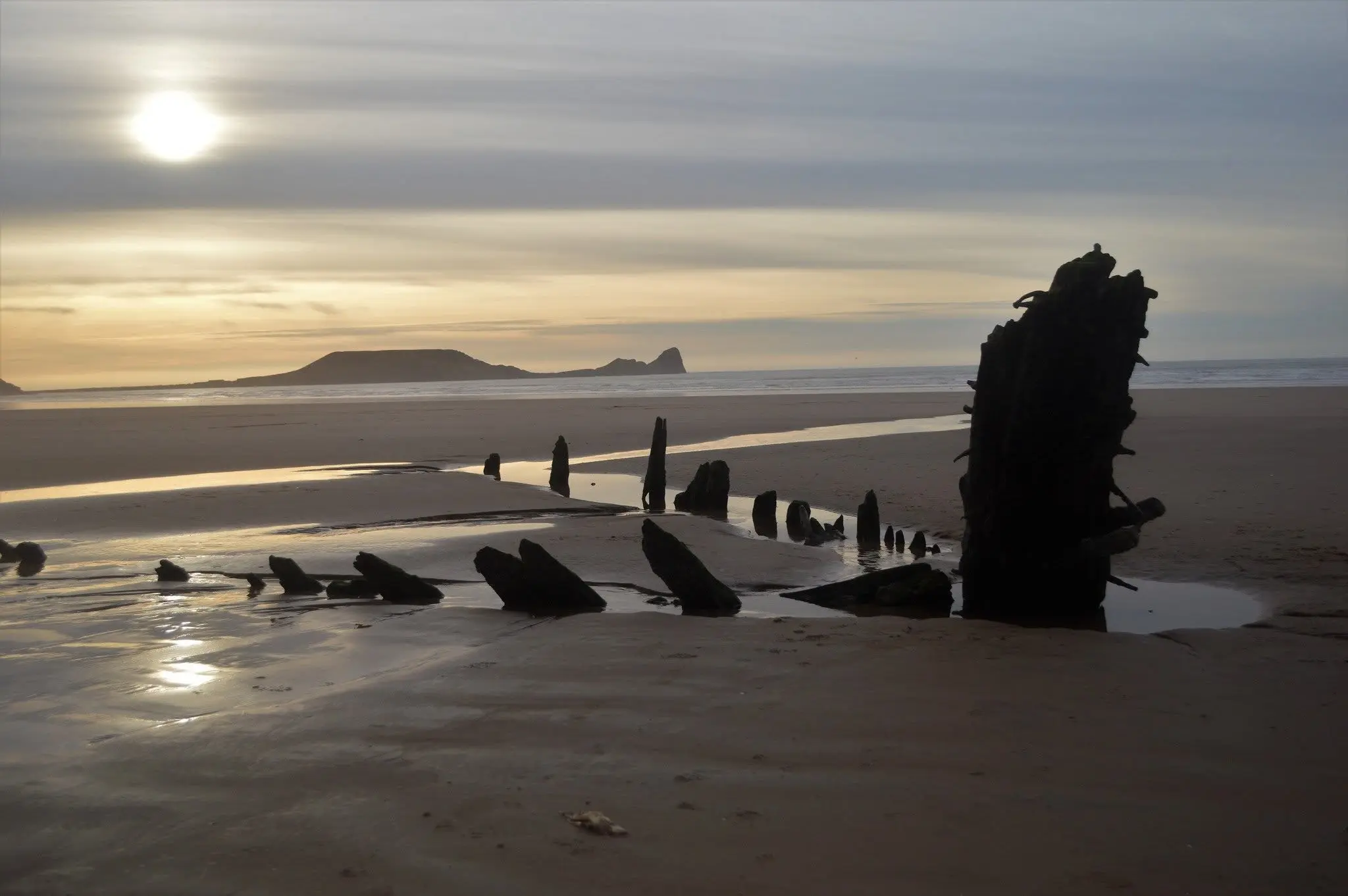 Photo courtesy of David Morgan
The Helvetia is the most famous wreck in the bay, and her ribs still rise from the sand below Rhosili.
She was a Norwegian barque carrying around 500 tons of timber from Campbellton, New Brunswick, to Swansea. On the stormy evening of 31 October 1887 she arrived off Mumbles, just five miles from her destination. A rising south-easterly wind stopped her from reaching harbour. By the next morning a gale was driving her down the Bristol Channel.
She struck the Helwick sandbank, which you can see four miles out from our lookout, but a lucky swell lifted her free. She was then swept around Worms Head into Rhosili Bay, where she anchored. Captain Stevenson was taken ashore by the Coastguard, but he ordered his crew to stay aboard to guard the cargo from looters. By nightfall the gale had ripped her anchor from the seabed, and the crew abandoned ship. All of them reached the shore safely.
By morning the Helvetia lay wrecked high on the beach, her timber scattered all around. The salvaged cargo was auctioned to South Wales timber merchants. A local man bought the wreck itself, hoping to strip her valuable copper, but she sank into the sand before he could. Local stories say he settled for her deck boards, which became his kitchen floor, and that much of her timber found its way into buildings across Gower.
The story had a sad postscript. The following spring, the Llanelli steamer Cambria came to collect timber and almost capsized in a heavy swell, losing her anchor. When a boat later went ashore to recover it, the weight of the anchor and six men proved too much. The boat overturned, and only one of the six made it back to shore alive.
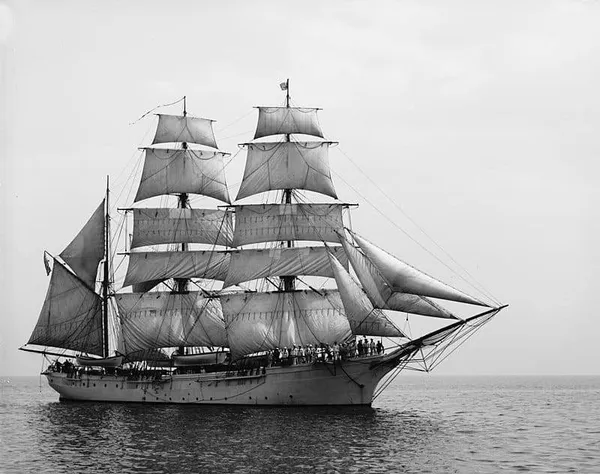
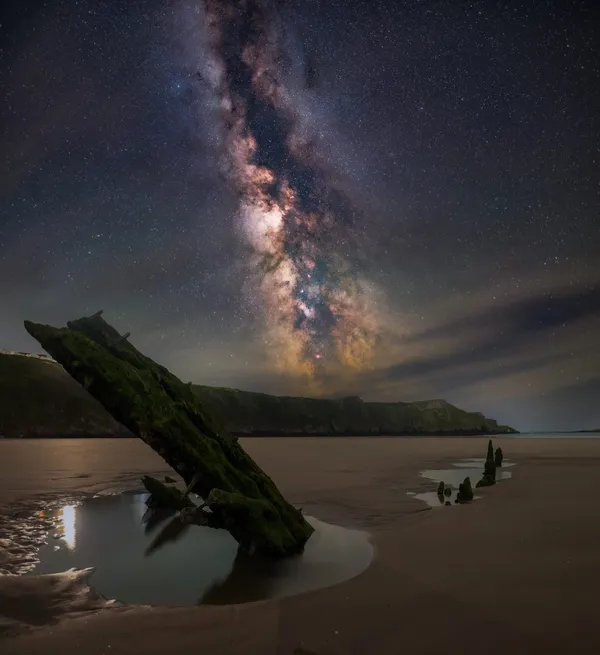 Photo courtesy of David Spencer
The Samuel (1884)
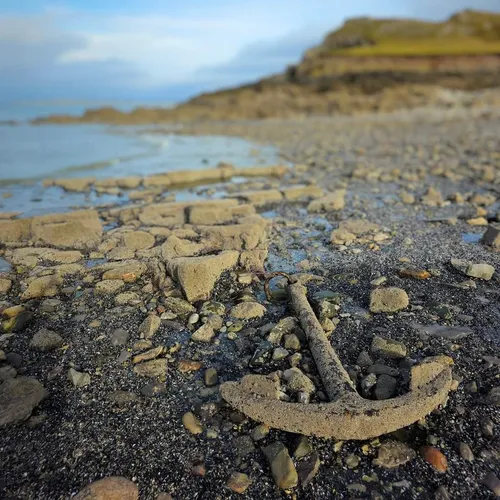 Photo courtesy of Martin Jones
As you cross the causeway to Worms Head, look out for an old anchor bedded among the rocks and mussels. It is thought to belong to the Norwegian barque Samuel. She ran ashore at 7pm on 12 February 1884, carrying coal from Cardiff to Santos in Brazil.
The Rhosili Coastguard spotted her lights close inshore, raised the alarm and got a line across, rescuing all eleven crew. The ship broke up on the rocks. Local farmers cut a rough track down to the wreck and carried off her coal, which kept homes warm for many winters. Look carefully near the anchor and you may still spot small pieces of coal.
More Wrecks Around the Headland
The City of Bristol (1840)
This 210-ton wooden paddle steamer left Waterford, Ireland, for Bristol on 17 November 1840. The next day, in rising winds and poor visibility, her captain tried to shelter behind Worms Head, but she ran aground just after 6pm. The seas were too high to abandon ship, so passengers and crew lashed themselves to the rails.
Shortly after midnight she broke into three. Twenty-seven people lost their lives. Only two survived, thanks to remarkable luck and the help of local people. Three bullocks and five pigs also swam ashore. The remains of her boilers can still be seen at very low tide.
The Vennerne (1894)
This 275-ton barque was sailing from Aberdovey to Swansea when rough seas forced her to shelter behind Worms Head. She dragged her anchor and was driven ashore below the cliffs, just west of the headland. Her hull was sold at auction for £54, and her remains are still visible.
Other Losses
- The Elizabeth (1873): this coal-carrying smack, bound for St Malo, sank a few miles off Worms Head on 12 August 1873. Her ship’s boy drowned, but Captain Racour and three crew were picked up by the Folkestone schooner Pet.
- The Smiling Morn and the Maria (1887): two Llanelli pilot boats were sheltering inside Worms Head during a thunderstorm when they became entangled and sank each other.
The Cave at the End of Worms Head
Worms Head is made of Carboniferous limestone and has three parts: the Inner, Middle and Outer Heads. They are linked by rocks that disappear and reappear with the tide. On top of the Inner Head are the remains of an Iron Age enclosure. The Middle Head is crossed by the Devil’s Bridge, a natural arch left behind by a collapsed sea cave. One day the arch itself will fall, just as the Green Bridge of Wales arch in Pembrokeshire eventually will.
At the very tip of the Outer Head, halfway down the cliff face, is Worms Head Cave. It was excavated three times between 1910 and 1990. Diggers found the bones of animals that once roamed here, including bear, wolf, wild cat, badger, reindeer and even mammoth, along with an Upper Palaeolithic stone blade. Most of the finds date from the Neolithic.
Together, these finds show that people used the cave on and off from at least 38,000 years ago right through to the Neolithic, around 6,000 to 4,400 years ago. When it was first used, sea levels were far lower and the coast lay many miles away. The Bristol Channel was a broad valley, and from the cave mouth people may have looked out over the river that would one day become the Severn Estuary.
Courtesy of Lee Horatio Walker.
From Rocket Station to Lookout
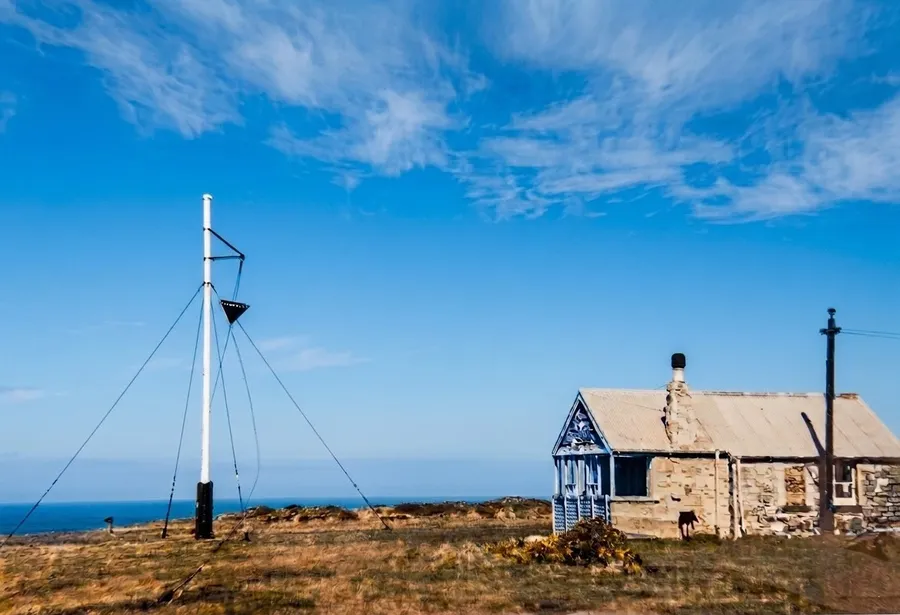
The story of a coastal watch at Rhosili goes back further than many visitors realise. In 1876, the Board of Trade set up a lifesaving apparatus station here, equipped with rocket-fired rescue lines and a horse-drawn rocket cart, to reach ships wrecked on this notoriously dangerous stretch of coast. The rocket cart shed built for it in 1878 still stands today as a listed building.
Around 1896, HM Coastguard built the watch station that still stands on the headland, staffed 24 hours a day. In the 1970s and 80s the Coastguard closed many of its lookouts, and Worms Head was one of the first to go. The hut went on to serve as an RSPB observatory, an artist’s studio and an information centre before falling derelict, until a group of local volunteers brought it back to life and began keeping watch at Easter 2007. Read the full story of our lookout →
Kitchen Corner
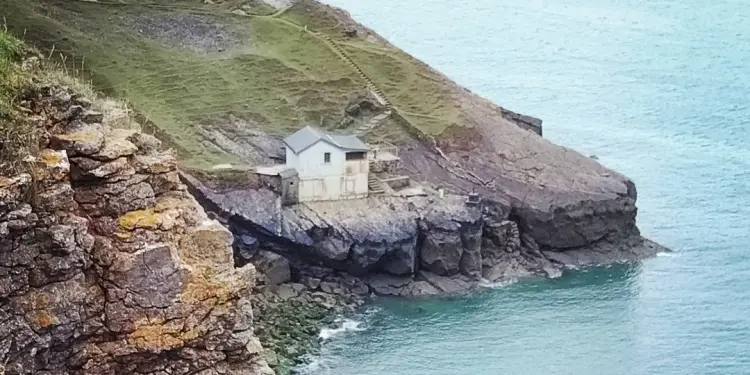
Kitchen Corner is the sheltered inlet just north-east of the causeway, below the old Coastguard Lookout. Its stepped rock ledges look natural, but were largely cut by post-medieval limestone quarrying — stone blasted from the cliffs above, slid down chutes still visible in the cliff face today, and shipped out by small boats to lime kilns across the Bristol Channel.
Just to the right of the path down to the causeway is its best-known feature: a small two-roomed boathouse, built in the 1920s right at the water’s edge by Swansea fisherman Mr Coonan as a dry store and fishing base. Like our lookout, it has no mains water, electricity or drainage, and it has never been lived in permanently. The name’s origin isn’t formally recorded, but local tradition points to it being the quarrymen’s sheltered lunch spot.
The stepped area on its seaward side is where the lifeboat lands people who have been cut off by the tide on the island. Being brought back this way is a long climb up the path. It’s a good reminder to check the safe crossing times before you set out, and if you do get cut off, to stay put and call 999 for the Coastguard.
The Gower Peninsula
In 1956, Gower became the UK’s first Area of Outstanding Natural Beauty, now known as a National Landscape. Its landscape ranges from the mudflats of the Loughor Estuary in the north, across rolling downland, to the high limestone cliffs of the south coast. Rhosili Bay’s three-mile beach is regularly voted one of the best in the world.
The name Rhosili is thought to come from the Welsh rhos, meaning moor, combined with the personal name Sulien. Above the beach, Rhosili Down rises to The Beacon, at 193 metres the highest point on Gower. The Down is scattered with prehistoric remains and the ruins of a Second World War radar station. Much of the land from Rhosili Down to Worms Head is cared for by the National Trust.
The Vile
Despite its name, there is nothing unpleasant about the Vile. The name is thought to come from the Old English gefilde, meaning field. It is a rare surviving medieval open-field system of long, narrow strips, which you pass on your way to our lookout. The strips are grouped into blocks with names such as Bramble Bush, Sandyland and Priest Hay.
The Vile is probably as old as the village and its church. It is thought to have been laid out after the Normans arrived in the 12th century, and was certainly in place by the 14th. It stayed largely unchanged for centuries, until farming changed after the Second World War.
Look out for its great perimeter wall, up to about two metres high and little altered since John Williams mapped it in 1780. The top of the wall overhangs outwards to stop sheep on the open coastal common from getting into the fields. Small pits along its southern and western stretches are thought to have been used when building and repairing it.
Today the National Trust manages the Vile and is restoring its historic boundaries. It is one of the few places in Britain where the pattern of medieval strip fields can still be seen.
Source: British Listed Buildings, Perimeter Wall of the Vile Open Field System.
St Mary’s Church & the Edgar Evans Memorial
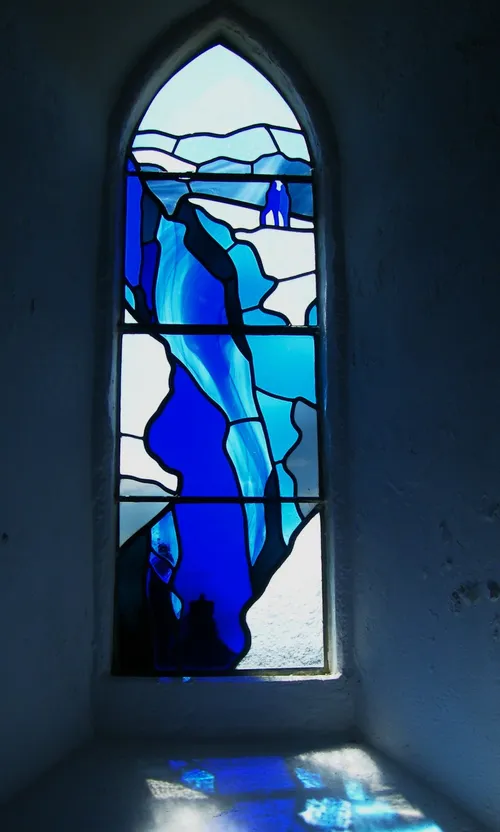
In the heart of the village, St Mary’s is Rhosili’s parish church, with parts dating back to medieval times. Inside is a stained-glass memorial window to Petty Officer Edgar Evans, a local man born nearby at Middleton.
Edgar Evans was a big, immensely strong man, chosen by Captain Scott to help haul sledges on the 800-mile journey to the South Pole. The party reached the Pole in January 1912, only to find Roald Amundsen’s Norwegian team had beaten them there.
On the return journey, Evans cut his hand while repairing a sledge runner, and the wound never healed. He later suffered a head injury in a fall into a crevasse. Weakened by injury, hunger and brutal weather, he collapsed and died in the early hours of 17 February 1912, the first of the party to die.
He left a widow, Lois, and three children. The memorial Lois placed in Rhosili Church can still be seen today, and a blue plaque marks his former home in Middleton.
Rhosili on Screen
Rhosili's sweeping beach and the Worm have made the bay a favourite with film and television crews. If some of these views look familiar, this may be why:
- Doctor Who — “New Earth” (2006)The TARDIS lands on the beach as the Doctor and Rose arrive on a far-future planet.
- Torchwood: Miracle Day (2011)The Old Rectory and the bay feature in the series, from its opening episode onwards.
- Mumford & Sons — “Lover of the Light” (2012)Idris Elba directed and starred in the music video, which ends at the edge of the cliffs.
- London 2012 Olympics opening ceremonyA youth choir sang “Bread of Heaven” on Rhosili beach, broadcast into the Olympic Stadium.
- Britannia (Sky Atlantic, 2018)Princess Kerra rides along the beach, with the Worm in the background.
- The Guest (BBC One, 2025)The Old Rectory became Fran and Ria’s clifftop home, and a dramatic scene was filmed on Devil’s Bridge.