The Rocks Beneath Your Feet
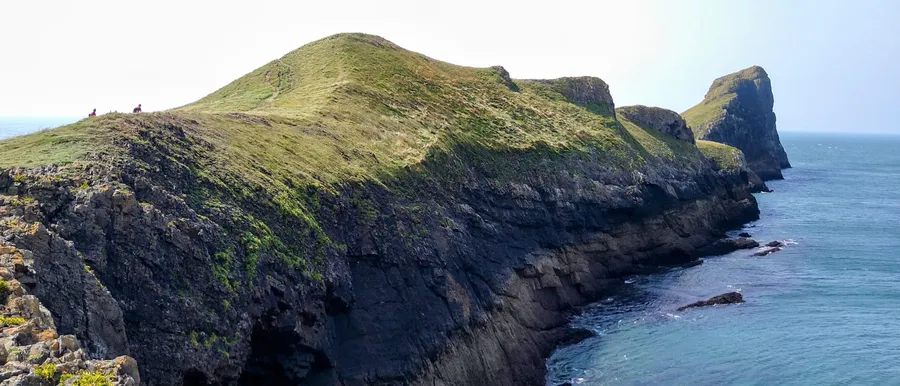
Worms Head is made of Carboniferous Limestone, laid down around 350 million years ago, when Gower lay near the equator beneath a warm, shallow tropical sea. The limestone formed from the shells and skeletons of countless sea creatures — and look closely and you can still find their fossils in the rock, including corals and the ring-shaped stem pieces of crinoids, or “sea lilies”.
Around 280 million years ago, as ancient continents collided, a mountain-building event known as the Variscan squeezed these flat layers into great folds. Worms Head sits on one of them — the Worms Head Anticline — which is why the rock layers on the Worm tilt so steeply, at up to 70 degrees in places. The jagged, slanting ridges you scramble over on the causeway and the Low Neck are the upturned edges of those layers.
The causeway itself is a wave-cut platform: a shelf of rock planed flat by the sea at the foot of the cliffs. Waves working at weaknesses in the limestone carved out Devil’s Bridge and the blow hole, and the Ice Ages added the finishing touches — raised beaches and cave deposits in the cliffs still mark where the sea once stood higher than it does today.
The Blow Hole & Devil’s Bridge
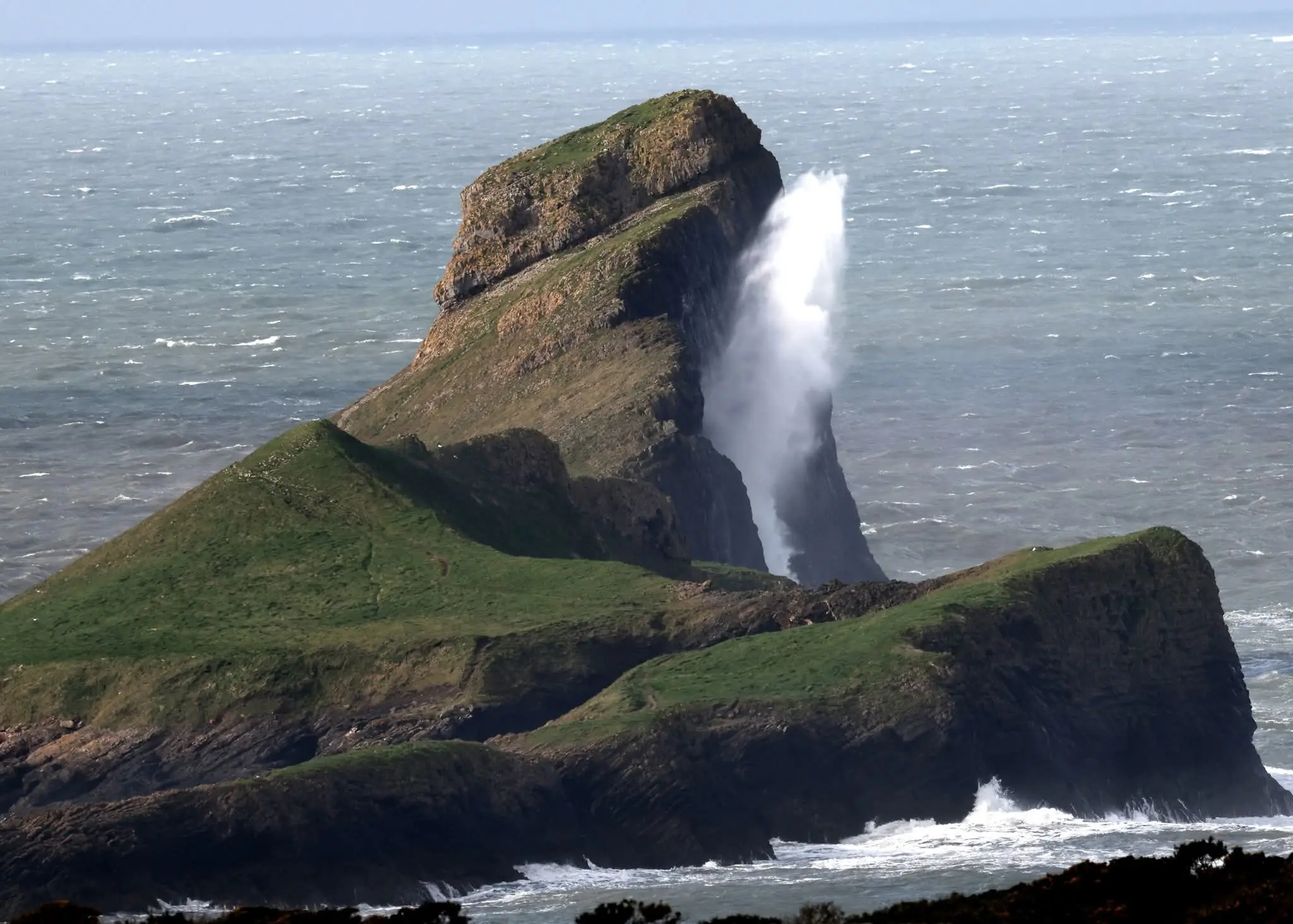 Photo courtesy of Jessica Crumpton
Near the Outer Head lies the famous Blow Hole. Connected directly to an undersea fissure, during heavy westerly gales and rising high tides, ocean surges compress air inside the chamber, propelling loud booming blasts and columns of sea spray high into the air.
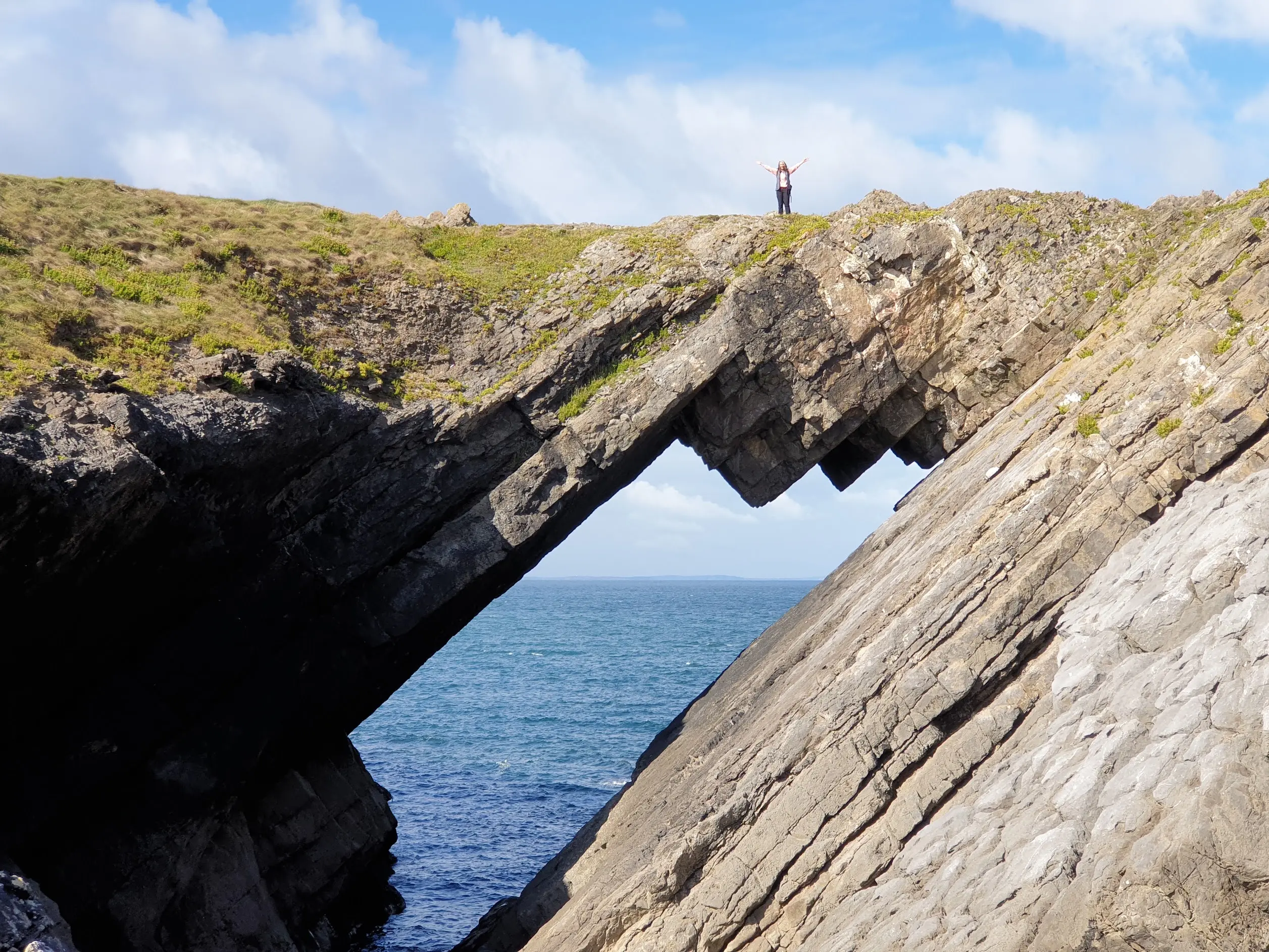
Between the Inner and Middle Heads sits Devil’s Bridge, a dramatic natural limestone arch carved by Atlantic waves. Visitors crossing the bridge must take extreme caution; the fall on either side is precipitous.

See the Worm from the Sea
Prefer to watch the seals from a safe distance on the water, rather than the clifftop? From the Lookout Station you may well spot the Sea Serpent, the wildlife boat run by Gower Coast Adventures, rounding Worms Head on one of its trips — a roughly 2-hour outing from Oxwich Bay past the Worm, with a good chance of seeing seals, dolphins, and seabirds along the way without disturbing them.
Visit website →The Grey Seals of Gower
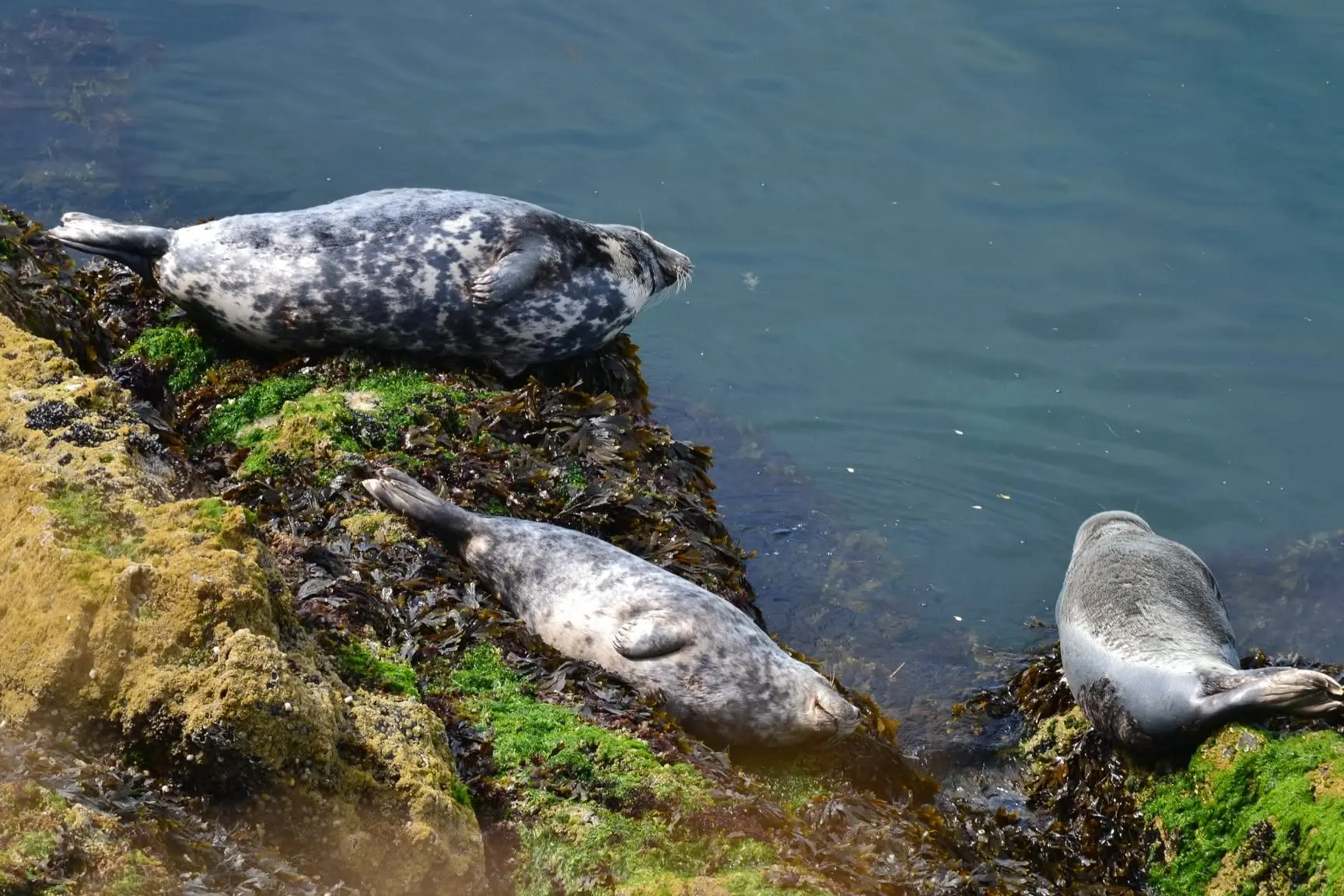
The seals you see around Worms Head are Atlantic grey seals, a species that is rare worldwide. Seeing them is always a good sign, because it means local fish stocks are healthy. Their favourite food is sand eel.
Remarkable Facts
- Long lives: females live to 30–35 years, and males to around 25.
- Great travellers: they can swim 50–60 miles a day and regularly visit Devon, Cornwall, Lundy and Pembrokeshire.
- Unique coats: no two seals share the same fur pattern, so individuals can be recognised from photographs wherever they turn up.
- Sleeping upright: they can sleep floating vertically in the water, known as “bottling”.
- Super-sensitive whiskers: they use their whiskers to detect fish.
- Deep divers: before a dive they breathe out and slow their heart from about 120 beats a minute to just 4. Using oxygen stored in their blood and muscles, they can dive to 120 metres for up to 15 minutes.
Pups and Family Life
Females usually give birth between August and December, returning to the same pupping site every year. A newborn pup weighs around 28lb. Its mother feeds it for 18 to 21 days, by which time the pup has grown to around 88lb and she has lost a third of her own body weight. Hunger then forces her to leave, and the pup must learn to feed itself, living off its fat while it does. Sadly, around 75% of pups die in their first 18 months, from bad weather, human disturbance and entanglement in nets and litter.
After leaving her pup, the female mates with the dominant male, known as the Beachmaster, who guards his group of females from rivals. Because she is in no condition to carry a pup straight away, the fertilised egg waits around three months before it starts to develop. The pregnancy then lasts another eight and a half months, so in effect she is pregnant for eleven and a half months.
Seal facts and photo courtesy of Gareth Richards, Gower Seal Group.
Please Give Seals Space
Seals need to haul out onto rocky ledges to rest and digest their food. Every time they are disturbed, they waste precious energy, and repeated disturbance can do them serious harm. Please enjoy them from a distance, keep dogs under close control, and never approach a seal or pup on the shore.
Swap to Seal-Safe: Flying Rings
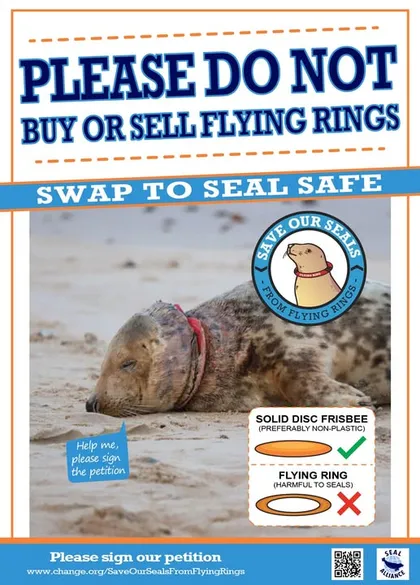
Flying rings, the hollow ring-shaped frisbees, are a real danger to seals. A curious seal can push its head through the ring, which then tightens around its neck as it grows, causing painful and sometimes fatal wounds. A solid disc frisbee, ideally not made of plastic, is a safe alternative.
The Seal Alliance is campaigning to stop flying rings being sold. Please don’t buy or bring flying rings to the beach, and if you’d like to support the campaign, you can sign the petition.
Birds of Worms Head & Rhosili
From the lookout we see a remarkable range of birds through the year, from seabirds nesting on the cliffs of the Outer Head to birds of prey hunting over Rhosili Down.
The Chough
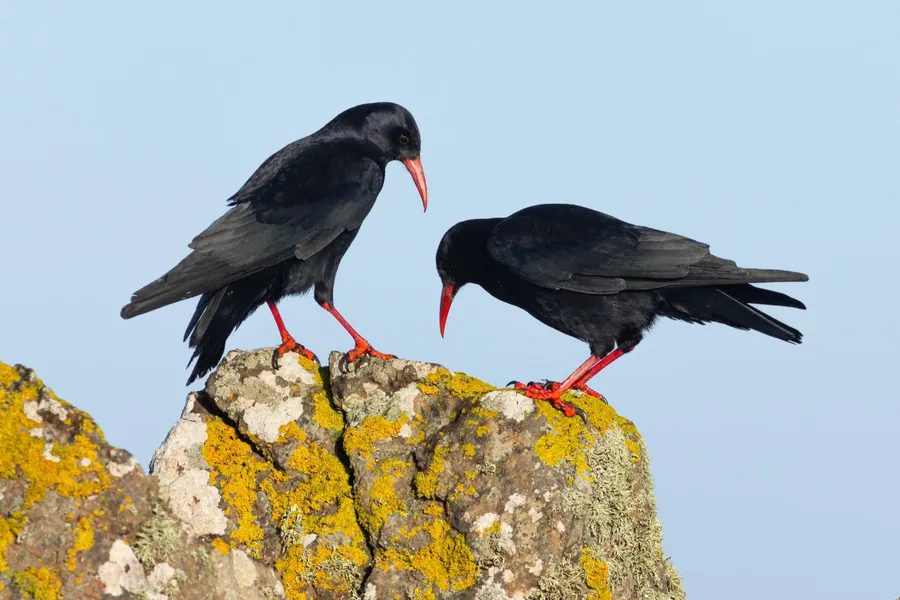
Look out for the chough: a member of the crow family with a bright red, curved beak, red legs and a loud “chee-ow” call. Choughs probe the short clifftop turf for insects and grubs, and they are wonderful acrobats in the wind along the cliffs. They came back to Gower in the 1990s after an absence of more than a hundred years, and are now one of the special birds of this coast.
Seabirds
Each spring and summer the cliffs of the Outer Head become a busy seabird colony. Kittiwakes are the most numerous, alongside guillemots and razorbills, with a few fulmars, shags and gulls. That is why the Outer Head is closed to visitors from 1 March to 31 August. Puffins once nested on the Worm too, until rats wiped out the colony. From midsummer, Manx shearwaters and storm petrels pass offshore, and in winter divers and common scoter feed on the sea.
On the Down and the Clifftops
On Rhosili Down and the clifftops, look for stonechats perched on top of the gorse, flicking their tails and calling with a sharp “tak-tak”, like two pebbles knocked together. Linnets gather in twittering flocks over the heath and the fields of the Vile, the males with rosy-pink breasts in spring. From March, wheatears arrive from Africa and bob along the short turf, flashing their white rumps as they fly off.
Dartford warblers breed in the gorse and heather, skylarks sing overhead, and you may spot a kestrel hovering or a peregrine or merlin hunting. Whitethroats and swallows arrive for the summer, while rock pipits and oystercatchers work the shoreline below.
Wildflowers, Butterflies & Bees
The clifftops and limestone grassland of the south Gower coast are full of flowers from spring to autumn. In spring, look for the small blue stars of spring squill in the short turf. Later come sea stork’s-bill, rock samphire and golden samphire on the cliffs, tall pink tree mallow, and late-summer flowers such as early gentian and goldilocks aster.
The coast has some real rarities too. Yellow whitlowgrass, a tiny yellow flower that blooms on the limestone rocks in early spring, grows wild in Britain only on the cliffs of Gower. The rocks are also home to unusual lichens, including the threatened scrambled-egg lichen.
On warm, sunny days, butterflies such as common blues, meadow browns and small heaths are out along the coast path and the flower-rich field margins around the Vile. The National Trust’s farming here, with hay meadows, wide wildflower margins and the summer sunflower fields, has given a big boost to pollinators: the bees in the sunflower fields alone are now estimated at around a quarter of a million.
Look closely and the heath and grassland are alive with insects too. The bloody-nosed beetle, a slow, round black beetle, oozes a drop of bright red fluid when it feels threatened, while the metallic green tiger beetle races across bare patches on Rhosili Down. Rare moths such as the silky wave and the narrow-bordered bee hawk-moth live here as well, and brown hares can sometimes be seen in the fields.
Please stay on the paths and leave the flowers for others to enjoy. Many of these plants are protected, so never pick or dig them up.
A Protected Landscape
The land and sea around Worms Head are some of the most carefully protected in Wales. Gower was the first place in the UK to be named an Area of Outstanding Natural Beauty, back in 1956, and is now known as the Gower National Landscape.
The cliffs, rocky shore and Worms Head itself are protected as Sites of Special Scientific Interest for their limestone grassland, seabird colonies and the wildlife between the tides. Much of the coast is cared for by the National Trust as part of the Gower Coast National Nature Reserve, and Rhosili Down is common land where animals still graze, as they have for centuries.
Even the night sky is protected. In 2025 Rhosili was recognised as an International Dark Sky Community, and on a clear night a look up from the clifftop shows you why.
All of this is why it matters so much to stay on the paths, keep dogs under close control and give wildlife plenty of space.
Recent Wildlife Sightings
Seals, dolphins, porpoises, seabirds and the occasional surprise: here is what watchkeepers and visitors have spotted around Worms Head recently.
Loading recent sightings…
Tell Us What You Saw
Don’t approach it, keep dogs and people well back (at least 100 metres from seals), and call British Divers Marine Life Rescue on 01825 765546 (24 hours). Never try to put a stranded dolphin or porpoise back in the sea.